
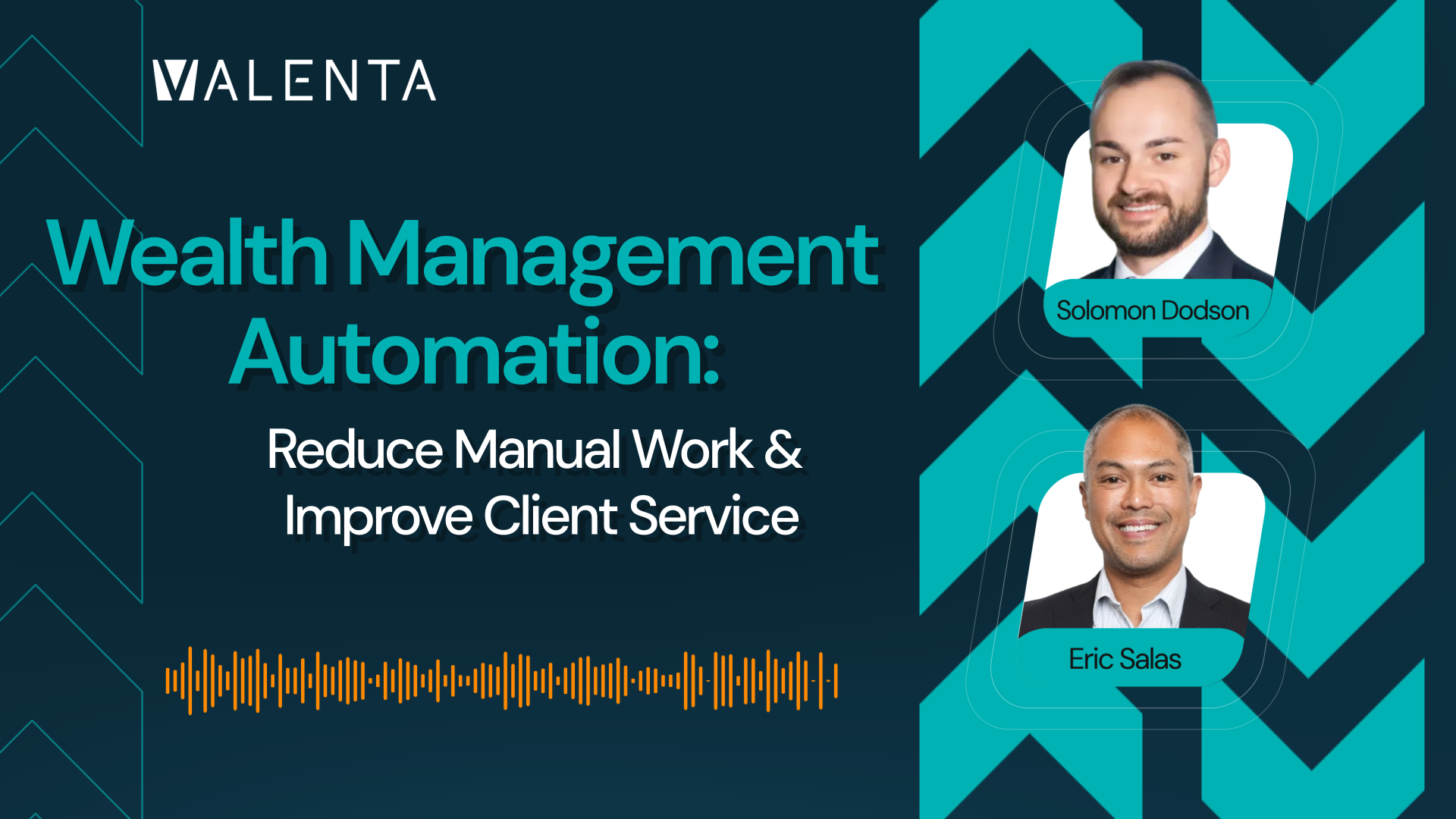
Wealth management has a reputation for being slow to adopt new technology. Ask Solomon Dodson why, and he doesn’t blame the tools. He blames priorities.
“The people starting firms and growing those firms are focused on just that: building relationships, finding clients, growing the top line,” says Solomon Dodson, who spent over four and a half years working inside wealth management operations before joining Valenta. “A lot of times what they’re overlooking is the ops side of things.”
That blind spot has a real cost. In the latest episode of Automation Unpacked, Dodson sat down with Valenta’s VP of Marketing Eric Salas to break down what that cost actually looks like, and where firms should start fixing it.
The 20-Tab Problem
Before joining Valenta, Dodson spent his days bouncing between three or four disconnected systems: a CRM, a custodian platform (Schwab, Fidelity, Altruist), and a portfolio management system like Orion or Tamarac. Each one might hold a different version of the truth about a client.
“I would have twenty Chrome tabs open at once,” Dodson says. “Client calls in, you’ve got to log into your system, maybe it timed you out, you log back in, you match all that client data. That might take two or three minutes.” Add finding the right form, filling it out, routing it through DocuSign, and checking for missing fields, and a single request can eat up thirty minutes. At $25 an hour, that’s real money spent on work that doesn’t move the business forward, and time an advisor isn’t spending on clients.
Where to Start (It’s Not a Full Tech Overhaul)
One of the biggest misconceptions Dodson hears from firm owners is that automation means ripping out their entire tech stack. It doesn’t.
“Your employees hate new technology. They hate learning new systems, new workflows. If they can offload it to a bot [Digital Assistant], that’s ideal. The workflow stays intact. They know what to expect. It just gets done.”
Solomon Dodson
Managing Partner Consultant
His advice for firms unsure where to begin: start with the communication loop between advisors, traders, and client service teams around account activity, things like an ACH deposit, a new account transfer, or a cost basis check. It’s high-frequency, rules-based, and rarely requires judgment calls, which makes it a low-risk, high-visibility place to prove out automation before tackling bigger workflows.
Does Automation Help or Hurt Compliance?
Compliance is often the first objection firm owners raise. Dodson’s answer might surprise them: automation is often more compliant than manual work, not less.
“Every process, every workflow is auditable,” he says. “If we can go back and see exactly what failed, fix it for next time, that’s typically what happens.” Compare that to relying on a person’s memory of a task from three months ago. “Something would pop up that I did wrong and I’d have zero clue what happened. I didn’t recall it. If a bot had done it, we would know exactly what happened.”
That said, automation isn’t meant to replace every human touchpoint. “When it comes to client outreach and dealing with clients directly, you want that human touch,” Dodson says. Given the fees clients pay, they expect white-glove service, not a bot on the other end of a call.
The Industry is Heading Here Regardless
Dodson points to a structural reality facing the industry: the profession is projected to lose 100,000 advisors by 2030, and client service talent is already hard to find. Automating repetitive, low-value work isn’t optional forever. It’s how firms keep up with client expectations as the labor pool tightens.
There’s also a growth angle. With over 16,000 RIAs competing on speed, quality, and advice, firms that can onboard clients faster and more accurately have a real edge. And for firms eyeing acquisitions or looking to be acquired by a larger aggregator, having automated, streamlined operations is a force multiplier. It makes integrating a newly acquired firm easier and can improve the valuation multiple of the business itself.
Three Things to Do First
Dodson’s advice for any firm ready to get started:
- Put together a small internal team, people who already understand the business, to audit current workflows and identify where advisor time is going.
- Check with your compliance team on feasibility before building anything.
- Start automating the repetitive, rules-based processes first, and build from there.
“You don’t need a professional consultant to do that for you,” he notes, though for firms without the internal bandwidth, that’s exactly where a team like Valenta’s, which combines automation expertise with real wealth management operations experience (paraplanners included), can accelerate the process.
Watch the full conversation of Automation Unpacked and reach out to Solomon or Eric if you want to talk through where automation could fit in your firm.
Want to see how Intelligent Automation could help your advisory firm?
Get your complimentary Automation Assessment to prioritize a quick win for your business.