
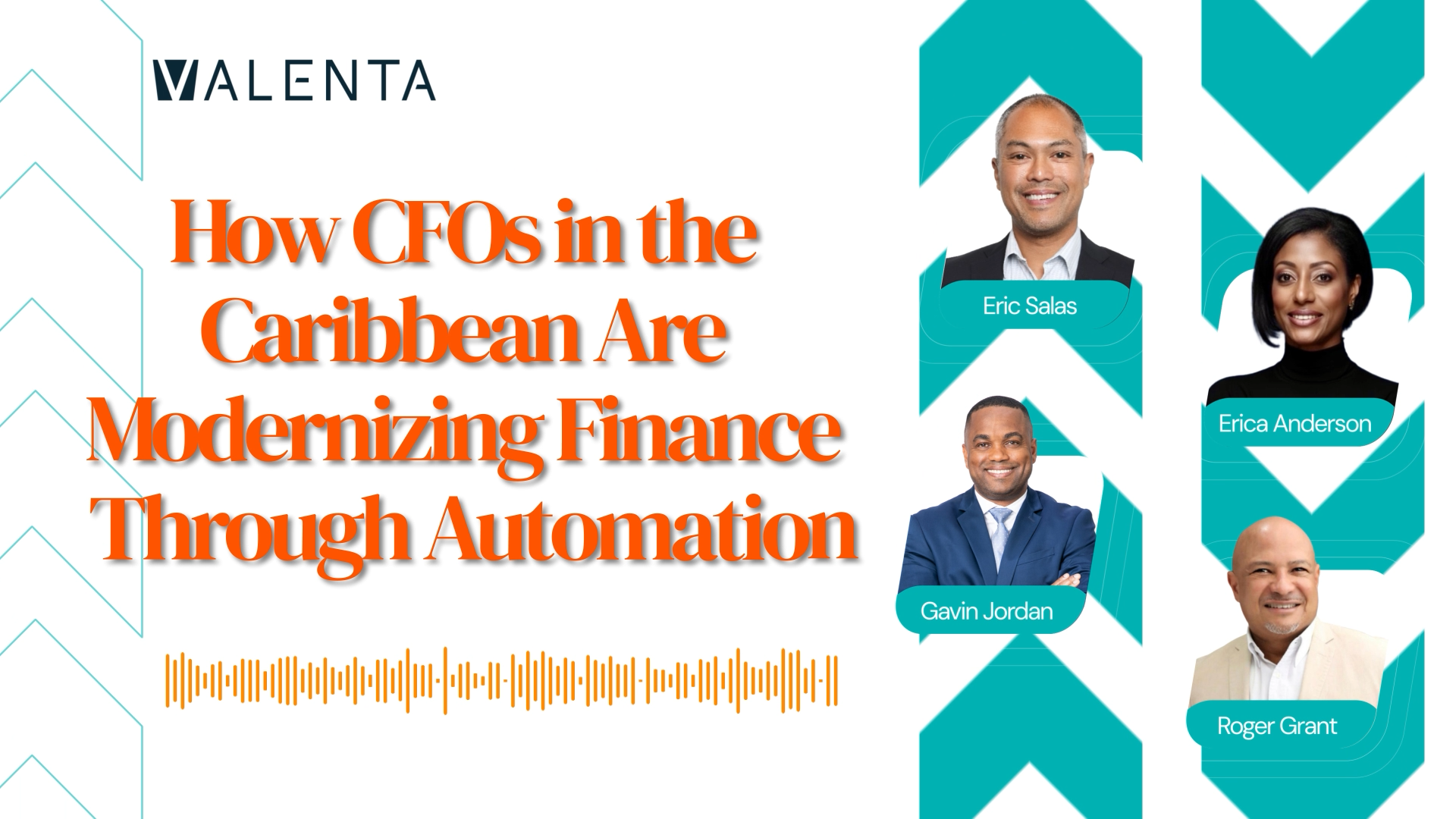
Ask a finance leader in the Caribbean what's holding their team back, and the answer usually comes fast: we can't find the talent. Ask Gavin Jordan, a former CFO who's held the seat six times across the Caribbean, the US, and Europe, and now runs his own advisory practice redesigning finance functions, and he'll tell you that's not the real problem.
In the latest episode of Automation Unpacked, Jordan sat down with Valenta Caribbean's Roger Grant and Erica Anderson to talk about what's actually broken in finance teams across the region, and it isn't a staffing gap. It's the manual work sitting underneath it.
The Real Cost of Manual Work
Jordan has worked inside finance functions with upwards of 50 bank accounts, reconciled by hand, weekly, with hundreds of thousands of reconciling items. “Even the most talented among us as finance persons have to jump in from time to time to help with reconciliations,” he says. The result is a function full of capable people who never get to be strategic, because they're too busy doing work a bot should be doing.
That gap shows up on the numbers side too. Anderson has seen businesses lose visibility into their own receivables because they're relying on manual entry for information that should update in real time. “If you don't know your exact cash flow, you can run into a really bad bind,” she says, and for listed companies, repeated errors in audited numbers can put a company's standing with regulators at risk.
Where to Start (It's Not a Full Rebuild)
One of the biggest misconceptions Grant hears from prospects is that automation means a multi-million dollar build or a hiring spree. It doesn't.
“Think big, but start small. Pick that one process that would really be a force multiplier if you automated it, and start there. Let us walk through it, understand it, automate it. Then you see the ROI, and you build a roadmap from there.”
Roger Grant
Managing Partner, Valenta Caribbean
Jordan's own methodology, built for larger finance-function overhauls, starts from the opposite direction: what does the CEO and board actually need from finance that they're not getting today? From there, he works backward to figure out what should be automated, outsourced, or restructured, rather than automating whatever's easiest first. Skip that step, as Grant puts it, and “the analogy I like to use is paving over a completely broken up road. It looks great on top, but underneath it's not functional.”
Does Automation Reduce Headcount?
It's a fair question, and Jordan's answer is direct: no. “It's not a matter of automation to reduce headcount,” he says. “It's automation to unlock latent value that's being constrained by manual work.” The goal isn't fewer people, it's freeing up the people already there to do the advisory, strategic work the business actually needs from finance.
There are benefits beyond strategy, too. Grant points to resiliency, since the Caribbean's exposure to hurricanes and supply chain disruption means processes tied to specific people can grind a business to a halt when those people can't get to the office. Automated processes don't have that dependency. Taking manual handoffs out of the loop also reduces opportunities for fraud.
The Industry Is Heading Here Regardless
The talent shortage is real, even if it isn't the root cause. Anderson says she gets calls on a daily basis from businesses looking for accountants and CFOs who simply don't exist in the local market in the numbers needed. Automation doesn't solve the shortage, but it plugs the gap on repetitive, lower-value work so the people who are available can focus where they add the most value.
There's a retention angle too, and it may be the most human point in the whole conversation. Anderson has watched accountants work “round the clock, all day, all night, on weekends” during close cycles, and says the businesses that give that time back are the ones that keep their best people. Jordan backs this up from the other side of the table: “I've spoken to several finance leadership personnel over the last few months, and one thing that shocked me is how many of them are close to handing in their resignation.” Businesses that invest in structure and automation now, he says, will have a real advantage in who they can hire and keep.
Three Things to Do First
Pick one process, not twenty. Find the single workflow eating the most time or creating the most risk, and prove out automation there before building a bigger roadmap.
Look at structure before tools. Buying software without first understanding what the business actually needs from finance is how firms end up automating the wrong thing.
Loop in the people doing the work. The staff running these manual processes today know exactly where the bottlenecks are, and their buy-in is what makes a wider rollout stick.
Watch the full episode of Automation Unpacked and reach out to Roger or your local Managing Partner if you want to talk through where automation could fit in your finance function.
Want to see how Intelligent Automation could help your finance function?
Get your complimentary Automation Assessment to prioritize a quick win for your business.